
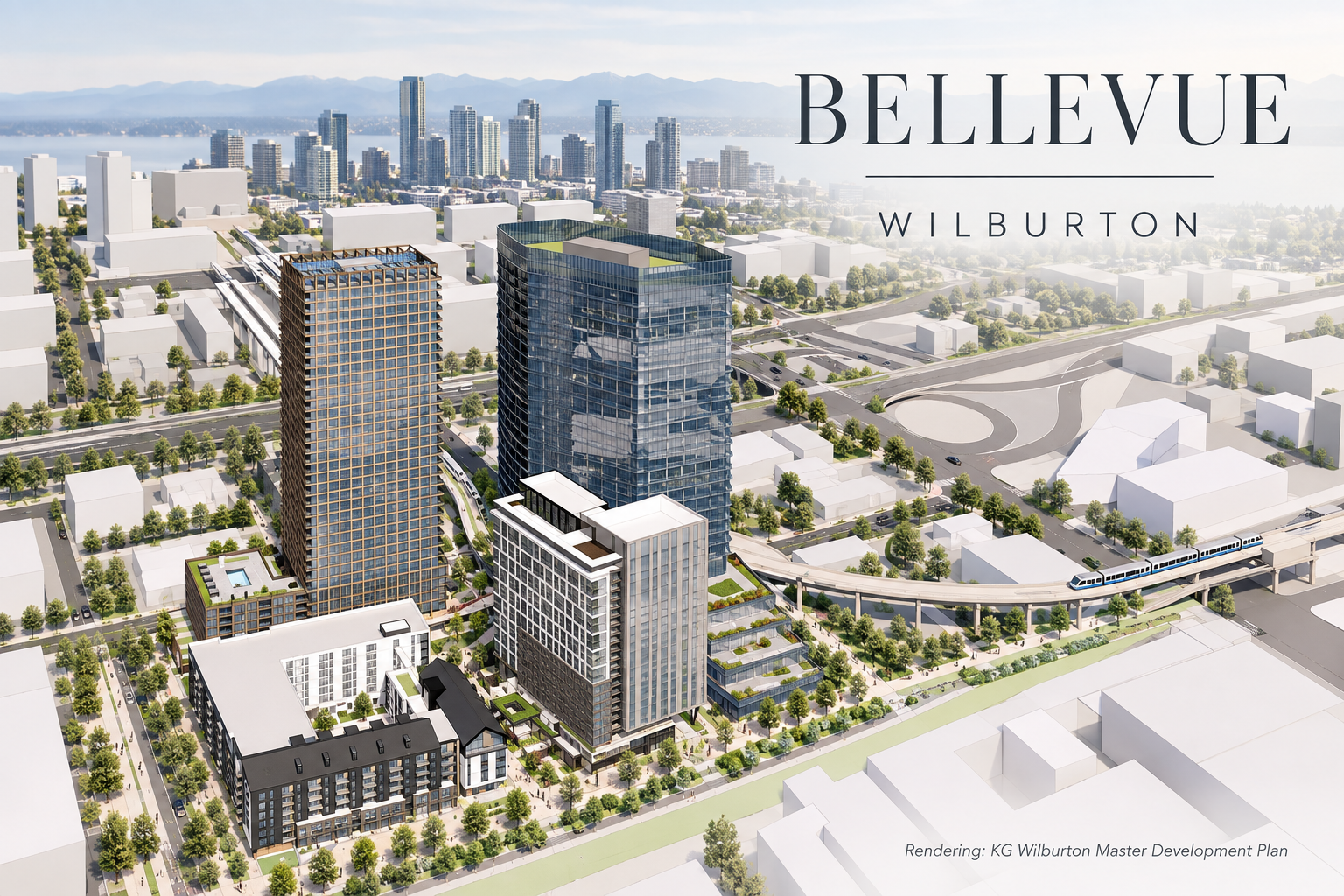
Bellevue is entering a major development cycle. Preliminary permit data from the first half of 2026 shows Bellevue receiving applications for more new multifamily housing than Seattle. The comparison is based on permit-intake data and remains preliminary, but it points to a larger shift: Bellevue is becoming one of the region's most active centers for new housing development.
But the more interesting story is not simply how much housing is being proposed. It is where Bellevue is choosing to grow.
A Different Kind of Bellevue
For decades, areas like Wilburton and BelRed were dominated by auto-oriented commercial and industrial uses. That is changing.
Bellevue's Wilburton Vision is designed to transform approximately 300 acres into a more walkable, mixed-use, transit-oriented neighborhood. The city adopted the land-use code changes needed to implement that vision in 2025.
The goal is not simply to add buildings. Bellevue's planning documents specifically call for development that takes advantage of investments in light rail, Eastrail and the Grand Connection, with mixed-use neighborhoods designed around transit, jobs, services and public spaces. That is a significant change from the Bellevue of the past.
Wilburton Is a Good Example
Wilburton may be one of the clearest examples of how the Eastside is evolving. The area is being planned as a connection between Downtown Bellevue and Eastrail, with new housing, commercial uses, open space and transportation infrastructure layered into the neighborhood.
The city describes the transformation as a shift from an "old auto row" toward a more walkable urban neighborhood, supported by light rail, Eastrail and the Grand Connection.
The city is also pursuing development on its own land. One Wilburton property was selected for an affordable housing project with at least 127 homes, located adjacent to Eastrail and the 2 Line light rail station.
And the development is not happening in isolation. Bellevue is planning the Grand Connection Crossing, a pedestrian and bicycle connection over I-405 that will link Downtown Bellevue with Wilburton and Eastrail. The city anticipates the initial crossing opening in 2030.
BelRed Is Following a Similar Path
BelRed is another example of Bellevue deliberately changing the character of an existing commercial and industrial area.
The city originally planned BelRed as a series of compact, mixed-use neighborhoods organized around new light rail stations. Today, Bellevue is continuing that strategy through its BelRed Look Forward plan, which is intended to increase capacity for housing and job growth and update the area's development regulations.
The city is also actively pursuing housing on publicly owned land near transit. In 2025, Bellevue sought development proposals for three properties in BelRed and Wilburton that together could produce as many as 850 new homes.
This is not accidental growth. It is planned growth.
Why Transit Matters
One of the most important themes running through Bellevue's development strategy is proximity to transit. The region's 2 Line connects South Bellevue, Downtown Bellevue, Wilburton, Spring District, BelRed and Overlake, creating a series of transit-connected nodes across the Eastside.
The Puget Sound Regional Council's review of Bellevue's comprehensive plan specifically recognized the city's approach to transit-oriented development around light rail stations and its new Wilburton neighborhood plan.
In other words, Bellevue is not simply adding density wherever land happens to be available. It is concentrating much of that growth around transit, employment centers, trails and existing infrastructure.
What This Could Mean for Eastside Real Estate
For homeowners and buyers, this is worth watching. Development can change more than the number of homes in a neighborhood. It can change the amenities, transportation options, housing choices, commercial activity and overall character of an area.
It also means that when evaluating a property, the neighborhood should not be viewed as static. A buyer considering a home today may be buying into a neighborhood that looks very different five or ten years from now.
That does not automatically mean development will increase or decrease the value of an individual property. The effect will vary depending on location, property type, surrounding development, infrastructure and buyer preferences.
But it does mean that what is planned around a property deserves the same attention as what is currently on the property.
The Bigger Picture
Bellevue's development story is ultimately about more than apartments. It is about how the Eastside is preparing for its next phase of growth. Downtown Bellevue is becoming more connected to Wilburton. BelRed is continuing its transition from an industrial area into a mixed-use district. Light rail is creating new transportation connections. And projects like the Grand Connection are designed to physically connect neighborhoods that were previously divided by I-405.
For Eastside real estate, that creates an important question: When you are evaluating a property, are you looking only at the home, or are you also looking at the neighborhood's trajectory?
Because sometimes the most important thing to understand about a property is not what is there today. It is what is being built around it.